
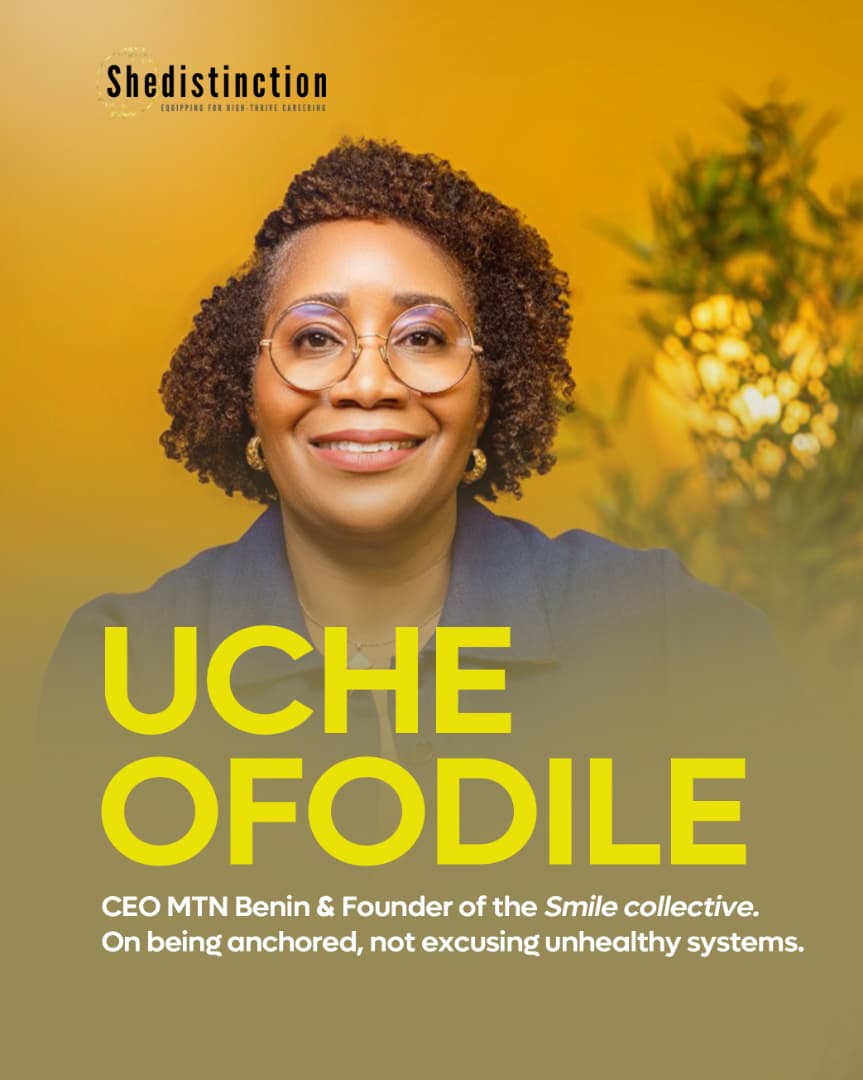
‘’Leaders who compound their influence over time are often those who’ve developed the discernment to know what a moment actually needs from them. The transitional spaces are where most leadership growth actually happens. Leaders who don’t metabolise loss end up leading from old wounds. Leaders who do can reset without dragging yesterday into tomorrow’’.
Uche Ofodile is a C-suite executive with over two decades of leadership experience across some of Africa’s most complex telecommunications markets. She leads MTN Benin, chairs MTN Mobile Money Benin, is founder of The Smile Collective, a leadership ecosystem exploring how leaders build internal stability, manage perception, and exercise power responsibly over time and hosts the Don’t Let the Smile Fool You podcast. Uche is author of ‘’Beneath the Smile: Leadership Infrastructure’’ and ‘’Say Less’. She writes and speaks about what leadership truly requires and has championed real executive-seat experiences for young women across West Africa, expanding access to decision-making roles and contributing to measurable career advancement.
Congratulations on your new book — Beneath the Smile: Leadership Infrastructure — setting out the infrastructure metaphor of 5 floors namely Foundations, Support, Growth, Recovery, Presence, and the Basement underpinning all. What’s the significance of preceding the subtitle with a main title focused on ‘smile’?
The smile is the entry point. Most people encounter a leader through surface presentation: composure, warmth, apparent ease under pressure. When I titled the book Beneath the Smile, I wanted to honour that reality. The smile isn’t inherently deceptive — it can be completely genuine. But it can also conceal fragile foundations. The subtitle — Leadership Infrastructure — is where the real conversation begins. It asks: what is actually holding that smile up? What sits beneath whatever you’re projecting to the world?
The ‘Basement’ — a place to process grief, clarity and truth — is arguably the most challenging. With basements not routinely part of buildings in many places, that part of the infrastructure concept could be misused. How does a leader prevent the ‘basement’ becoming a dumping ground or hiding place?
Every leader has things they don’t talk about. Not just personal loss, but professional grief. The strategy you fought for that didn’t work. The promotion you expected that didn’t come. The team member you trusted who left. The public failure that stung more than you admitted. If you don’t process those moments, they don’t disappear. They sit quietly. And over time they change how you show up. You become more cautious or less trusting. Sometimes you start proving something instead of leading. A dumping ground is when you push those experiences down and move on as if they didn’t matter. A functional basement is when you pause long enough to ask: What did that cost me? What did it teach me? What am I carrying forward that doesn’t belong in the next season? It’s about being honest. Leaders who don’t metabolise loss end up leading from old wounds. Leaders who do can reset without dragging yesterday into tomorrow.
Your ‘floors’ framework is quite straightforward. Of course, sometimes one gets caught between floors — straddling intersections or stopping to catch one’s breath. How does one navigate no man’s land, the in-betweens, dilemmas etc?
The transitional spaces are where most leadership growth actually happens — and where most leaders panic. We’re taught to always have footing, to project certainty. But being between floors is legitimate. It’s not failure, it’s transition. The danger is forcing your way onto the next floor just to escape discomfort. The in-between carries information. If you sit with it, it tells you whether you’re moving forward in integrity or simply running. One practical thing would be to name where you are to someone you trust. The in-between loses much of its destabilizing power when it’s no longer a secret.
I like that you address the quiet realities of leadership across your platforms, because leadership discourses tend to over-focus on skills — and capacities such as judgement and the ability to anticipate get lost. With your experience in multiple markets, what are some quiet capabilities you would say compound a leader’s positive impact irrespective of context?
Three come to mind. First, reading the room at a systemic level — not just the people in it, but the forces shaping why they’re behaving as they are. Second, calibrated patience — knowing the difference between a situation that needs urgency and one that needs you to slow down. Many leaders destroy value by treating everything like a fire. Third, the discipline of the voice. Knowing when to speak, when to stay silent, and how to make every word carry weight when you do. Most leadership development focuses on how to communicate more — more persuasively, more confidently, more visibly. But the leaders who compound their influence over time are often those who’ve developed the discernment to know what a moment actually needs from them. That’s a capability that travels everywhere.
Many leaders try to cope with burdens by being resilient and expecting others to be so. Resilience has become the call card — but I have heard you refer to ‘bad resilience’. What is that and how can leaders avoid it, especially with all the pressure around to be resilient?
Bad resilience isn’t just about how you handle loss. It’s also about what you tolerate. It’s staying in consistently unhealthy work conditions and calling it grit. It’s working for a boss who undermines you and telling yourself you just need thicker skin. It’s absorbing unreasonable pressure because ‘that’s just how this industry is.’ Over time, you adapt, you become efficient at surviving, you learn how to function without sleep, without clarity, without support. And from the outside, it looks impressive. But inside, something shifts – you lower your expectations, you normalize behaviour that should never have been normalized, you stop asking whether the system itself needs to change.
Healthy resilience helps you recover from difficulty and grow stronger. Bad resilience trains you to endure dysfunction. The difference is this: are you bending temporarily and returning to yourself — or are you reshaping yourself to fit something broken? Resilience should not become an alibi for unhealthy systems.
Your approach of leading being about the leader — not just leadership — brings to mind a research report I saw recently that highlighted that ‘moral leadership is in high demand: 94% of employees believe the need for moral leadership is more urgent than ever.’ How in your view might stronger moral leadership look like in a workplace and in business?
Moral leadership is tone from the top. Whatever a leader tolerates, models, or chooses in a quiet moment becomes the culture. Moral leadership is most tested when things aren’t going well – when performance is under pressure, when results are disappointing, when you know that one small adjustment to how you frame things would make everything feel better — temporarily. That’s the moment that defines a leader. I’ve been in those moments. And I’ve always told my team: we give the bad news. We don’t dress it up. We don’t cut corners to make one meeting feel easier. Because the relief is temporary, and the cost — to your credibility, to your team’s trust, to the culture you’re building — is not.
What I’ve seen is that when you hold that line consistently, something shifts in the organization -people stop bracing for spin. They start trusting what they’re told. And when the good news finally comes, it lands differently because everyone knows it’s real. That’s what moral leadership looks like in practice. Not a values statement, a decision, made repeatedly, under pressure.
Your ‘CEO for a Day’ initiative is developing young women leaders effectively in terms of how much they are learning in just a day. What might other initiatives draw from it in designing for scale in the depth of impact potential of those who get equipped?
The design principle underneath ‘’CEO of the Day’’ is immersion with accountability. It isn’t observation. It isn’t shadowing. It’s real decision-making, with real stakes, followed by reflection. What we’ve learned is that confidence and visibility aren’t soft outcomes — they’re accelerators.
One story stays with me. A woman was chosen as CEO of the Day. Her boss extended it for a full month. Her boss eventually left. When the vote was taken for a new CEO, her name was on the list. They had watched her lead, how she handled the room, the decisions, the pressure. That visibility, that evidence, gave them the confidence to choose her. She became CEO.
That’s what the programme does. It puts women in the role — not a version of it, not a simulation — and people see them there. That’s what other programmes need to understand. You can teach a woman everything there is to know about leadership, but until others have witnessed her leading, the ceiling doesn’t move. Real experience, in a real room, changes what is possible.
Coming back to the subject of smile — you seem to have a special bond with it. Smile features in the title of your book and podcast, and you have The SMILE Collective. You smile a lot too, which has aided your composure in trying situations. What other traits or disciplines have helped you lead well that might surprise others?
Beyond the smile, I would say I don’t run from hard seasons. Leadership is easy to perform when things are going well. It is clarifying when they are not — when performance is under pressure, when scrutiny sharpens, when expectations feel heavier. Those moments reveal what is actually stable inside you. I have learned not to collapse under that weight. I allow myself to feel it — I don’t deny pressure — but I don’t let it rewrite my identity or distort my judgment. Secondly, I examine myself before I defend myself. If something isn’t working, I want to know why. If I’ve contributed to a problem, I would rather see it early than protect my ego. And finally, I do not negotiate my centre to make a room comfortable. I can adjust tone, I can adapt strategy, but I don’t reshape my standards to match the temperature of the moment. Formidability, for me, isn’t force. It’s staying anchored when the environment is unstable.
The interview was conducted by Vera Ng’oma